Compositional 3D Scene Generation Pipeline Diagram (Editable PowerPoint)
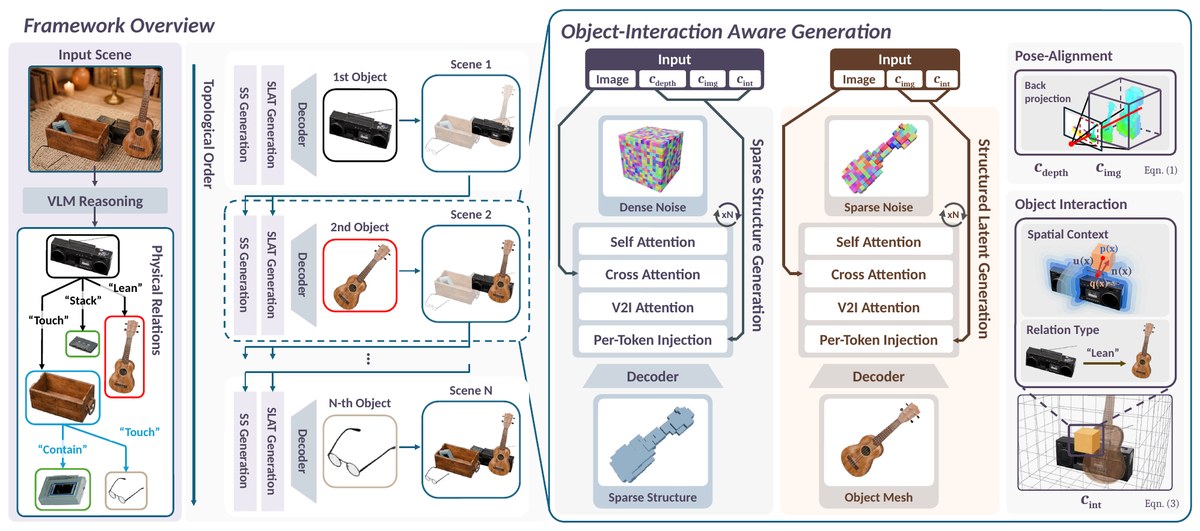
Overview
This editable PowerPoint diagram shows a physics-aware, object-by-object 3D scene generation pipeline. It is adapted from the original paper figure under CC BY 4.0.
What the diagram shows
On the left, an input scene goes through VLM reasoning into a physical-relation graph with Stack, Lean, Touch and Contain relations. In the middle, objects are generated in topological order, passing through SS generation, SLAT generation and a decoder to build scenes 1 to N. On the right, an object-interaction-aware generation panel holds two attention stacks (Self, Cross and V2I attention plus per-token injection) with their input pills, alongside Pose-Alignment and Object-Interaction side panels. Panels, blocks, trapezoid decoders, relation arrows, routing lines, loop icons and all labels are native shapes, ready to restyle for your own slides, posters or papers.
File format
The download is a single-slide .pptx file measuring 11.60 × 5.14 in. It opens in PowerPoint, Keynote, WPS and LibreOffice Impress. Google Slides works too, although small layout shifts are possible. A full-resolution preview.png and a 1200 px web preview are included.
Shapes and editing
The file has 227 elements in total: 205 native editable shapes (73 auto-shapes, 75 lines or connectors, 42 text boxes and 15 freeforms) and 22 embedded raster images. You can edit all text, including the vertical labels and math (cdepth, cimg, cint, p(x), u(x), q(x), n(x)), every panel and card, the Input pills, attention blocks and decoder trapezoids, the dashed Scene 2 frame and zoom lines, the relation-graph arrows, the topological-order routing, the ×N loop icons and the back-projection frustum and cube wireframe.
Embedded images and fonts
The 22 embedded PNG images have transparent backgrounds. They are the input-scene photo, the object renders (radio, ukulele, cassette, box, glasses and others), the composed scene 1, 2 and N renders, the dense and sparse noise voxels, the sparse-structure and object-mesh renders, the point-cloud backdrop in Pose-Alignment, the spatial-context glow image and the cint grid render. They are sharp (roughly 300–400 px per inch) and can be moved, resized or replaced, but you can't recolor or reshape them like vector shapes. The text uses Calibri and Cambria; missing fonts are substituted and some labels may need small tweaks. The figure's original framework title was replaced by the generic "Framework Overview". This is a faithful redraw for reuse, not the authors' original source file.
Source & license Adapted from Figure 2 of Tetris3D: 3D Scene Generation With Objects That Fit Together by Jaeyeong Kim, Jinhyuk Jang, Jongmin Lee, Kyehong Park, Seungryong Kim (arXiv:2610.10539, https://arxiv.org/abs/2610.10539; code: https://github.com/cvlab-kaist/Tetris3D). The original is licensed under CC BY 4.0 (https://creativecommons.org/licenses/by/4.0/). Converted to editable PowerPoint shapes; the panel title was made generic. Changes made by 叫我Alonzo就好了/alonzolab. Not endorsed by the original authors. Please keep the attribution (see LICENSE-ATTRIBUTION.txt) when you reuse the figure.