Test-Time Latent Reasoning Credit-Assignment Diagram
Overview
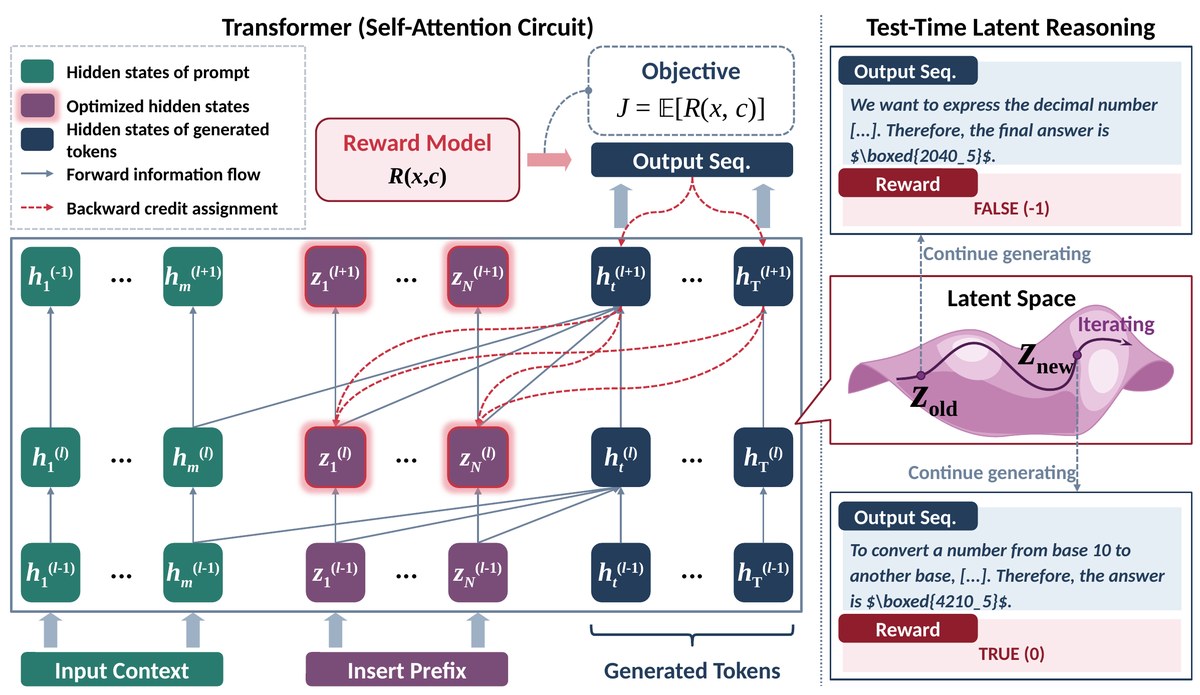
A two-panel diagram of test-time latent reasoning by gradient credit assignment. It is an editable PowerPoint diagram adapted from the original paper figure under CC BY 4.0.
What the diagram shows
Left, a transformer drawn as a self-attention circuit: three layers (l−1), (l), (l+1) of hidden-state tiles for the prompt (h1 … hm), an inserted prefix of optimised latent states (z1 … zN, glowing) and the generated tokens (ht … hT). Grey forward-information arrows link the layers, while red dashed backward credit-assignment arrows run from the output sequence through the top-layer states down to the prefix latents. A reward model R(x,c) scores the output sequence for the objective J = 𝔼[R(x, c)]; a legend explains the five marks, and Input Context / Insert Prefix / Generated Tokens bars sit below. Right, test-time latent reasoning: a first output (reward FALSE (−1)) → continue generating → a latent-space surface on which the prefix moves from zold to znew along an iterating path → continue generating → a corrected output (reward TRUE (0)). Every box, arrow, label and math term is a native shape you can recolor, resize and relabel for your own slides, posters or papers.
File format
The download contains .pptx (1 slide, 13.30 × 7.70 in; opens in PowerPoint, Keynote, WPS and LibreOffice Impress; Google Slides works too, but complex freeforms may shift slightly), .svg and .drawio. Includes preview.png (full resolution) and a 1200 px web preview.
Shapes and editing
The file has 115 native editable shapes: 47 auto-shapes, 27 text boxes, 18 freeforms, 23 lines/connectors (1 small group). No embedded images. Everything is vector. You can edit all text and math (h(l)1, h(l)m, z(l)1, z(l)N, h(l)t, h(l)T across three layers, R(x,c), J = 𝔼[R(x, c)], zold, znew), every hidden-state tile with its glow, the forward arrows and red dashed credit-assignment curves, the reward-model and objective cards, the legend, the input bars and bracket, the output-sequence and reward cards, the callout and the placeholder latent-space surface with its iterating path.
Embedded images and fonts
This file has no embedded images; everything is vector. The latent-space surface is a simplified vector placeholder made of a few flat freeform bands, not the paper's rendered surface. Body text uses Calibri and formulas use Times New Roman. Calibri ships with Microsoft Office and Times New Roman is preinstalled on Windows and macOS (LibreOffice substitutes the metric-compatible Carlito and Liberation Serif). The blackboard-bold 𝔼 uses Cambria Math, which ships with Microsoft Office; other apps substitute a math font. Sub- and superscripts are real formatted text runs, not equation objects. The SVG keeps text as text; the draw.io file is a shape-by-shape conversion and may need small nudges. This is a faithful redraw for reuse, not the authors' original source file.
Source & license Adapted from Figure 1 of GradCuit: Credit-Assigned Gradient Flow Enables Robust and Interpretable Test-Time Latent Reasoning by Zhaoxin Yu, Qi Shen, Hengli Li, Zhaowei Zhang, Song-Chun Zhu, Chi Zhang, Zilong Zheng (arXiv:2608.02585, https://arxiv.org/abs/2608.02585). Licensed under CC BY 4.0 (https://creativecommons.org/licenses/by/4.0/). Redrawn as editable shapes; changes made by 叫我Alonzo就好了/alonzolab. Not endorsed by the original authors.
Questions or feedback? Email [email protected]