Video LLM Token Budgeting and Selection Diagram
Overview
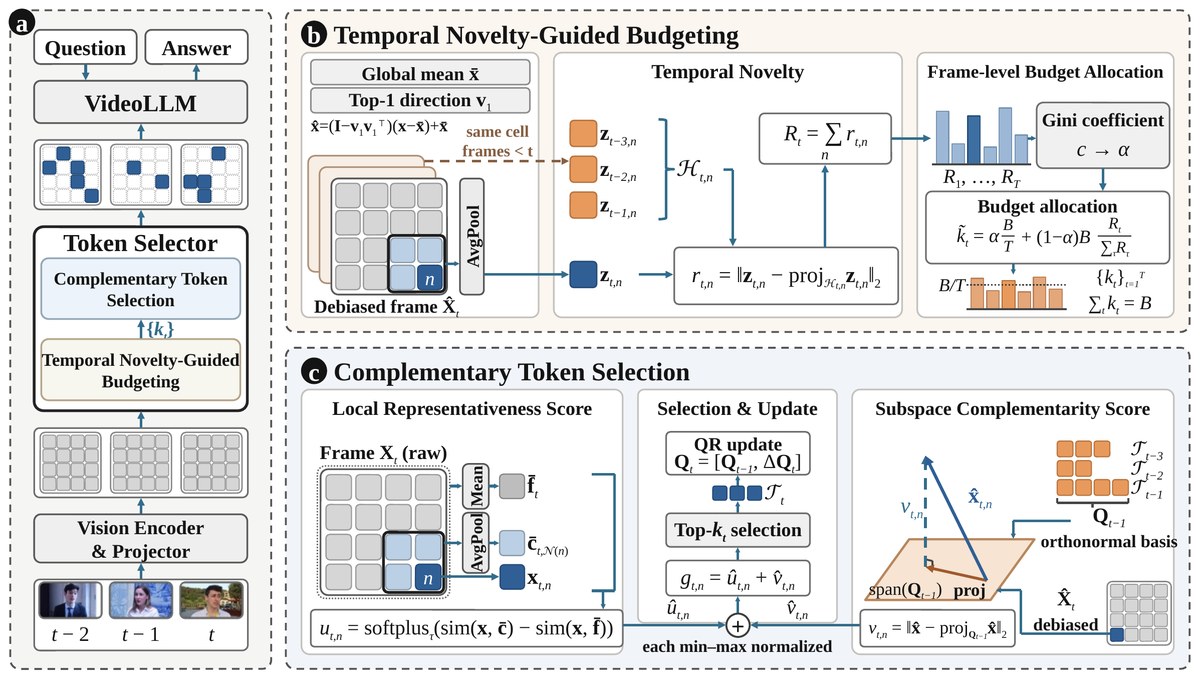
A three-panel diagram of training-free visual-token selection for a video LLM. It is an editable PowerPoint diagram adapted from the original paper figure under CC BY 4.0.
What the diagram shows
(a) Overall pipeline: frames t−2, t−1, t → vision encoder & projector → frame token grids → a token-selection module (temporal novelty-guided budgeting feeding per-frame budgets {k_t} into complementary token selection) → kept-token grids → VideoLLM → question / answer. (b) Temporal novelty-guided budgeting: a debiased frame x̂ = (I − v₁v₁ᵀ)(x − x̄) + x̄, AvgPool, residuals r_{t,n} against the same cell in earlier frames, frame novelty R_t, a Gini coefficient mapped to α and the budget formula k̃_t. (c) Complementary token selection: a local representativeness score u_{t,n} (mean / AvgPool neighbours with softplus), a subspace complementarity score v_{t,n} (projection onto span(Q_{t−1}) on an orthonormal basis), the summed score g_{t,n}, top-k_t selection and a QR update of Q_t. Every box, arrow, label and math term is a native shape you can recolor, resize and relabel for your own slides, posters or papers.
File format
The download contains .pptx (1 slide, 13.30 × 7.54 in; opens in PowerPoint, Keynote, WPS and LibreOffice Impress; Google Slides works too, but complex freeforms may shift slightly), .svg and .drawio. Includes preview.png (full resolution) and a 1200 px web preview.
Shapes and editing
The file has 342 native editable shapes: 230 auto-shapes, 58 text boxes, 1 freeform, 53 lines/connectors. 3 embedded images (see below). You can edit all text and formulas (x̂ = (I − v₁v₁ᵀ)(x − x̄) + x̄, r_{t,n} with the projection norm, R_t = Σ_n r_{t,n}, the k̃_t budget fraction, u_{t,n}, v_{t,n}, g_{t,n}, Q_t = [Q_{t−1}, ΔQ_t], ℋ_{t,n}, 𝒯_t), every token cell and frame grid, the stacked debiased frames, bar charts, the tilted subspace plane with projection vectors, the panel badges a / b / c, dashed panels and all arrows.
Embedded images and fonts
3 items are embedded images: the three example video-frame thumbnails (t−2, t−1, t). They come from the source figure at its resolution, so swap in your own frames for large prints. Text uses Times New Roman, which is preinstalled on Windows and macOS (LibreOffice uses the metric-compatible Liberation Serif). A few calligraphic math letters (such as 𝒩, ℰ, 𝒮) use Cambria Math, which ships with Microsoft Office; other apps substitute a math font. Sub- and superscripts are real formatted text runs, not equation objects. The SVG keeps text as text; the draw.io file is a shape-by-shape conversion and may need small nudges. This is a faithful redraw for reuse, not the authors' original source file.
Source & license Adapted from Figure 2 of GleanVID: Complementary Token Selection for Efficient Video Large Language Models by Shuo Yang, Changbai Li, Rui Tang, Xinyu Zhao, Linlin Yang, Baochang Zhang (arXiv:2609.37042, https://arxiv.org/abs/2609.37042). Licensed under CC BY 4.0 (https://creativecommons.org/licenses/by/4.0/). Redrawn as editable shapes; changes made by 叫我Alonzo就好了/alonzolab. Not endorsed by the original authors. Attribution to the original paper is required when you publish or share the figure; the exact credit line is in LICENSE-ATTRIBUTION.txt inside each download.
Questions or feedback? Email [email protected]